
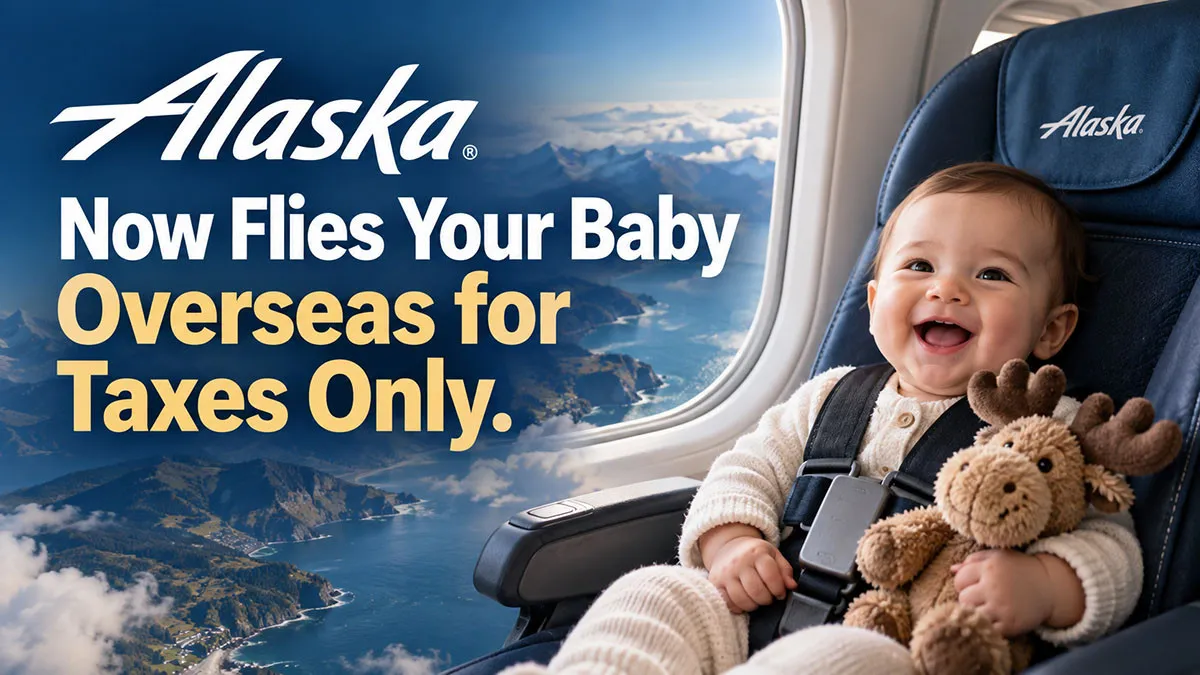
Atmos Rewards, the loyalty program of Alaska Airlines and Hawaiian Airlines, updated its lap infant policy in early September 2026. Adding a lap infant to an international award ticket now costs only government taxes, with no percentage of the adult fare. Every other major U.S. program charges 10% of the cash fare, which on a premium cabin ticket runs past $1,000.
The short version
- Atmos Rewards charges lap infants government taxes only on long-haul international awards.
- The industry standard is 10% of the adult cash fare plus taxes.
- On an international first class award, that 10% has hit $1,400 for a single infant.
- Air Canada Aeroplan, the previous best, charges 2,500 points or 25 CAD plus taxes.
- A lap infant is a child under 2 who travels on an adult’s lap with no seat of their own.
What exactly changed?
Alaska Airlines updated its lap infant policy page to reflect the new pricing. The page now reads: “For long-haul international Atmos Rewards bookings, lap infants are charged only the applicable international taxes.” Those are government-mandated taxes, not carrier-imposed fuel surcharges, which is the distinction that makes this generous rather than merely tidy.
An Alaska spokesperson confirmed to One Mile at a Time that the policy covers partner airlines too, as long as the ticket is issued on Alaska’s own ticket stock, which every Atmos Rewards redemption is. So a Japan Airlines or Qatar Airways award booked with Atmos points falls under the same rule. Some coverage has reported partner limitations, so call to confirm on your specific itinerary rather than assuming.
Why does 10% of the fare cost so much?
The industry norm ties the lap infant price to the adult’s cash fare, not to the award price. That is the part families miss. You redeem 70,000 miles for business class to Europe, feel good about it, then get quoted 10% of the $4,200 cash fare for the baby who does not get a seat.
Ben Schlappig at One Mile at a Time described canceling an American Airlines international first class award after learning the lap infant charge was over $1,400. That is not an outlier. On premium cabin awards, the infant frequently costs more than the taxes on all the adult tickets combined.
How does this compare to other programs?
Air Canada Aeroplan held the previous best policy, charging 2,500 Aeroplan points or 25 CAD per one-way plus taxes. That is a small, predictable number, and it made Aeroplan the default recommendation for families flying awards internationally.
American AAdvantage, United MileagePlus and Delta SkyMiles all follow the 10% convention on international award tickets. Domestic U.S. flights are the exception across the board: lap infants fly free within the United States on essentially every carrier, so this change only affects international itineraries.
Atmos Rewards now sits alone at the top. Taxes only beats 2,500 points, and it beats 10% of a fare by an enormous margin on any premium cabin booking.
How do you book a lap infant on an Atmos award?
You cannot add a lap infant to an Atmos Rewards award online. Book the adult award first, then call Alaska Airlines to add the infant to the reservation. Have the child’s date of birth ready, and confirm the quoted amount before the agent ticketing it, since the policy is new and agent familiarity varies.
One practical note. Book the adult seat during the sale windows Atmos runs, then add the infant. The Global Getaways promotion running through September 5, 2026 prices London and La Paz from 20,000 points one way, and the infant pricing applies on top of whatever award price you secured.
Is this a reason to switch programs?
For a specific group of people, yes. If you have a child under two and you are planning a long-haul trip in a premium cabin, the difference between Atmos Rewards and American AAdvantage on the same seat is potentially four figures. That is larger than most transfer bonuses, larger than most welcome offers, and it applies every time you fly until the child turns two.
For everyone else, this is a nice detail rather than a reason to move your points. Atmos Rewards has real weaknesses, including limited award availability on some partners and a points balance that is harder to top up than Chase or Amex. The lap infant policy does not fix those. Before shifting your earning, it helps to know what each currency is worth, which we cover in our guide to what points and miles are worth.
What this means for you
If you are traveling internationally with a baby in the next two years, price the trip through Atmos Rewards before you price it anywhere else, then call to add the infant. If you want to earn Atmos points directly, we looked at the co-branded option in our review of the Atmos Rewards Ascent Visa.
FAQ
What counts as a lap infant?
A lap infant is a child under two years old who travels on an accompanying adult’s lap without a seat of their own. Once a child turns two, a paid or award seat is required.
How much does Atmos Rewards charge for a lap infant now?
Atmos Rewards charges only applicable government international taxes for a lap infant on long-haul international award tickets. Carrier-imposed surcharges and a percentage of the adult fare are not applied.
Does the policy cover partner airlines?
Alaska Airlines has confirmed the policy applies on partner metal as well as its own, provided the ticket is issued on Alaska ticket stock, which covers all Atmos Rewards redemptions. Confirm on your itinerary when you call.
Can you add the infant online?
No. Atmos Rewards requires you to call Alaska Airlines to add a lap infant to an award booking. The option does not appear during online checkout.
Are lap infants free on domestic flights?
Yes. Lap infants travel free of charge on flights within the United States across essentially every U.S. carrier, so this policy change matters for international itineraries only.
Sources
- Alaska Airlines: Traveling with lap infants
- One Mile at a Time: Atmos Rewards introduces the best lap infant award policy
- Thrifty Traveler: Alaska and Hawaiian roll out the best lap infant award policy
- View from the Wing: Alaska now charges only taxes for lap infants
- One Mile at a Time: Infant award travel guide
- Alaska Airlines: September Atmos Members Day deals